State-mandated water standard could cost Joshua Basin Water District millions

Chromium-6 or hexavalent chromium is a naturally occurring heavy metal that can be found in groundwater sources like the the underground aquifers from which the Joshua Basin Water District (JBWD) pulls their water.
JBWD customers have been drinking that groundwater for years, and the chromium-6 that exists in Joshua Tree’s water is introduced as rain water slowly filters through the desert soil and settles deep underground, waiting to be pumped up into our homes at the turn of a tap. The naturally occurring chromium is different than the extremely toxic version of chromium which can be a byproduct of industrial processes, which was detailed in the movie “Erin Brockovich.”
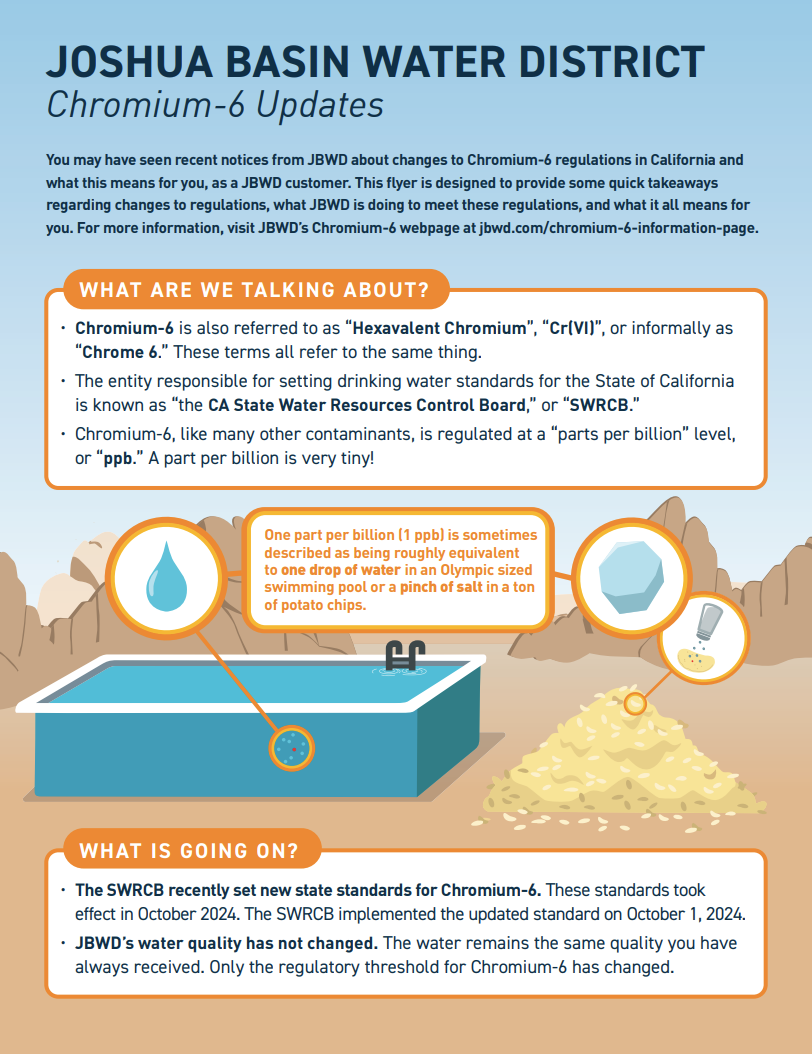
Comparatively, drinking water with naturally occurring chromium is safe to drink, but new evidence points to possible long-term effects that has California reacting with new regulations.
The water hasn’t changed, but the standard has
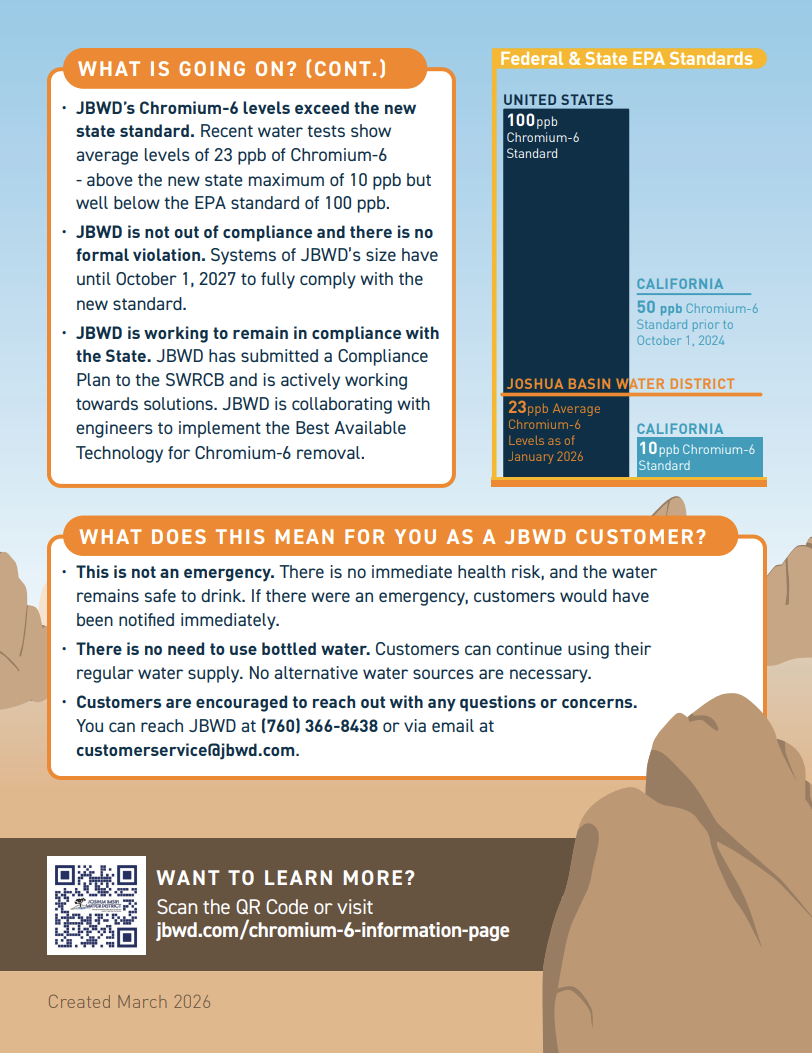
Those chromium levels have stayed pretty consistent over time, according to the Joshua Basin Water district. Groundwater taken from the five wells sit at an average of about 23 parts per billion (PPB). That number is well below the federal standard of 100 PPB, and until recently it was less than half of California’s previous threshold of 50 PPB.
Now the State of California’s State Water Resources Board has set the new “maximum contaminant level” (MCL) of chromium-6 to 10 PPB, and they say that the chemical is more harmful that previously realized when ingested over long periods of time. The new requirement is leaving water agencies like the Joshua Basin Water District with the problem removing what was previously thought of as a harmless heavy metal, along with figuring out how to fund it.
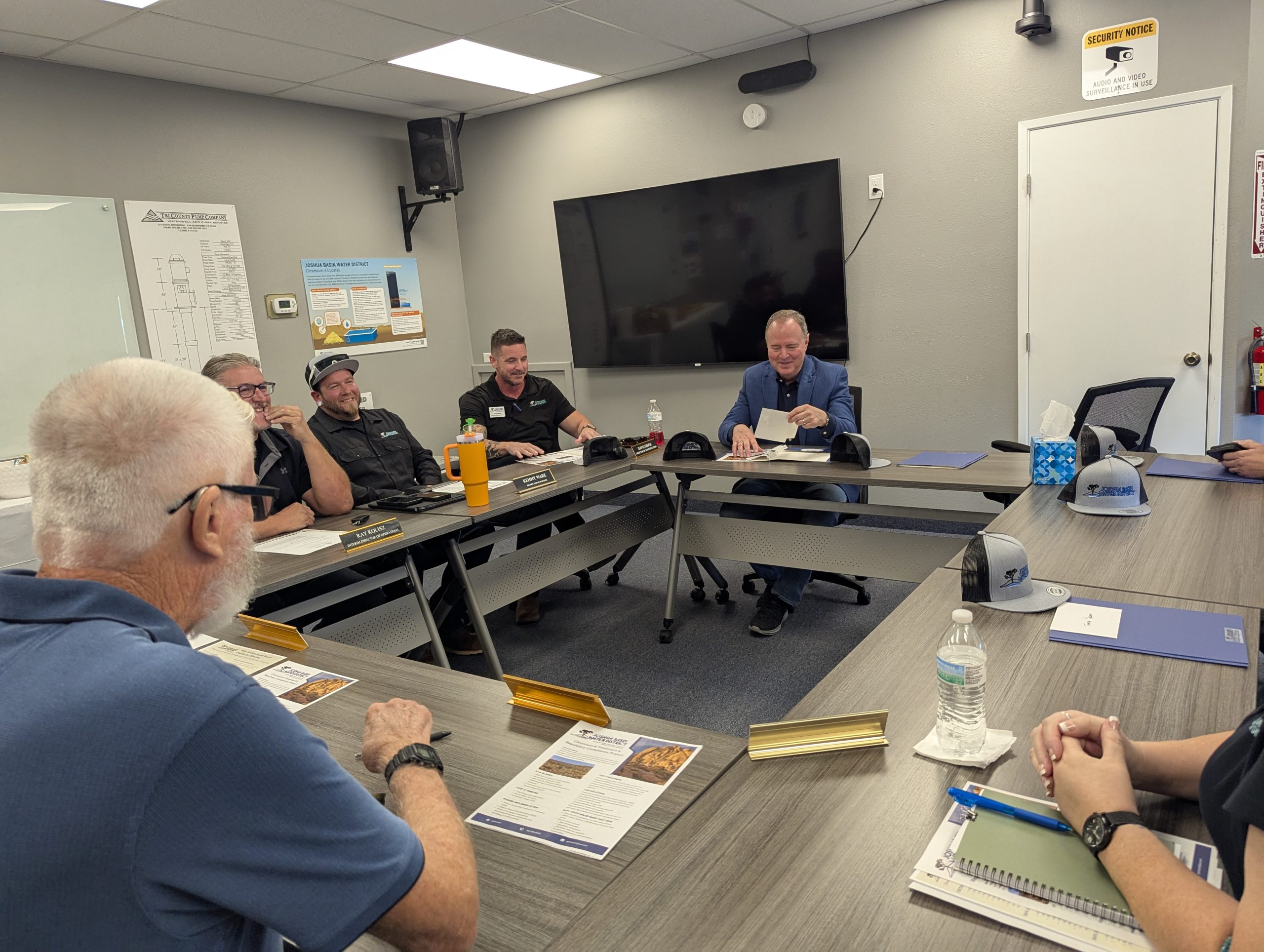
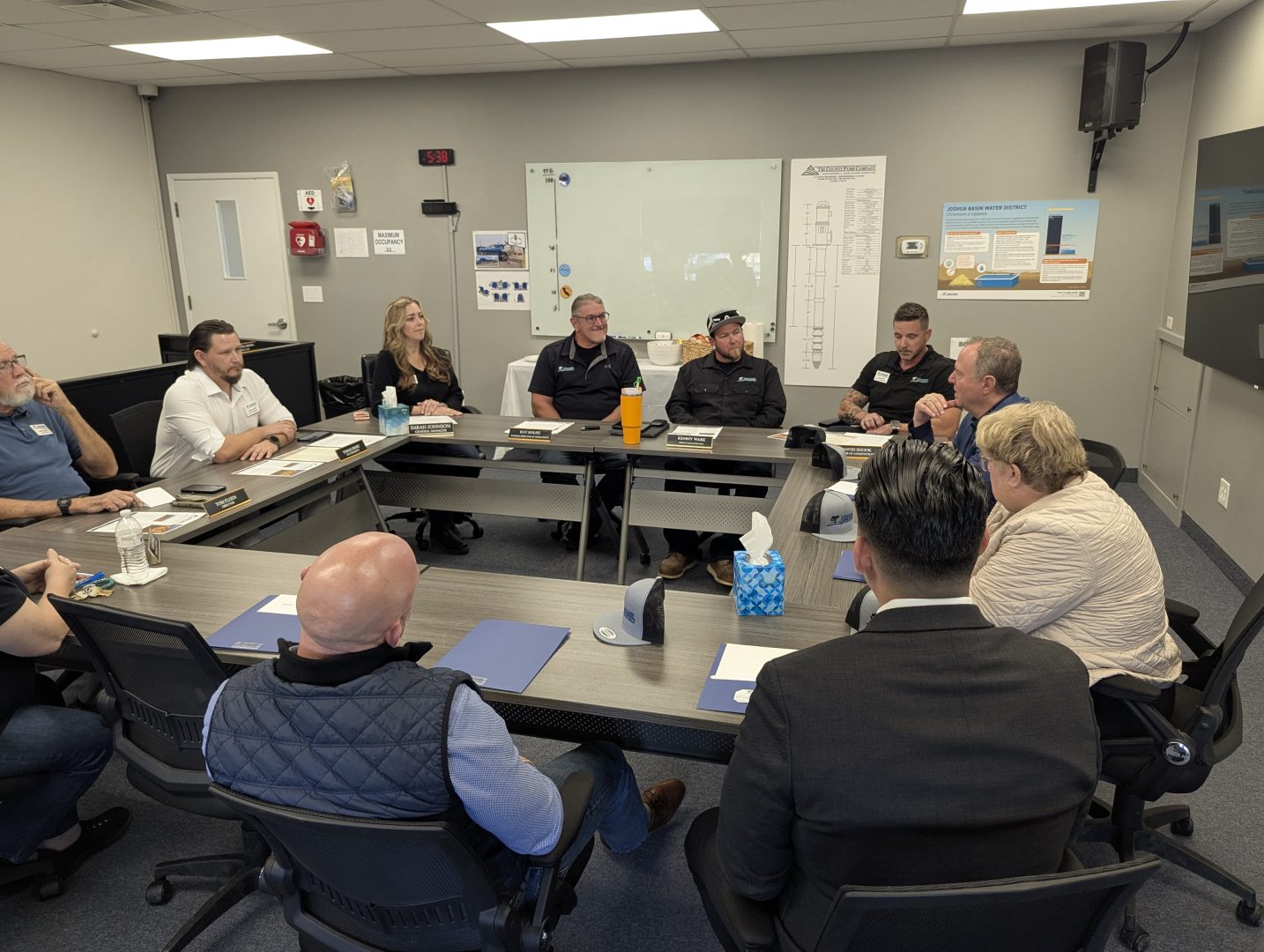
One of the key figures in the state’s new chromium-6 standard is United States Senator Adam Schiff. The Senator was in Joshua Tree on Monday, May 4th to visit Joshua Basin Water District and discuss how smaller communities like Joshua Tree will pay for chromium removal.
The path to a lower state standard for chromium-6
Adam Schiff served as the Representative for the 30th District of California from 2001 to 2024 and was responsible for securing funding for a study on chromium-6 with the National Toxicology Program, which he calls “the gold standard” in testing whether a substance is harmful to humans.
“They did this study and they determined it was carcinogenic, but at that time there was no way to get it out of the water. So I then worked with my local cities to get some federal funding to start a pilot project in a technology that was believed would be successful in removing hexavalent chromium. The technology worked. Since that time though, I’ve tracked what the federal government says about the safety of chromium in the water. The federal government has a much higher tolerance, meaning it allows a lot more than (California) state.
“So there are a lot of water districts that are now out of compliance with the state standard of 10 PPB as opposed to the federal standard, which allows 100 parts per billion. But recently, one of the federal agencies did another look at hexavalent chromium and found that it was likely to be more of a risk than previously known. So that just adds to the urgency.”
Senator Schiff says that his purpose for his visit was to meet with Joshua Basin Water District and see if there was federal funding that could help the water district meet the new state standard. Last year the Senator helped secure $2 million for the City of Indio for a recycled water project, which itself was a part of a larger $254 million federal funding package focused on housing, public safety and conservation efforts.

Chromium-6 could cost JBWD customers $20 to $60 million
According to an early figure shared at an April Joshua Basin Water District meeting, the cost to get the water district’s chromium-6 levels down to the new state standard could range anywhere from $20 million dollars for a “best case scenario” all the way up to $60 million dollars – an estimated price that has been hard to swallow for a “once in a generation” project in a small water district like the JBWD.
Joshua Basin Water District General Manager Sarah Johnson is the reason Senator Schiff was visiting the hi-desert. In February of 2026 Johnson and members of the JBWD board visited Washington D.C. where they met with Congressman Jay Obernolte as well as staff from Senator Alex Padilla and Senator Adam Schiff. She says they also attended a presentation with Senator Schiff but we’re unable to speak with him personally.
“I didn’t go all the way to Washington, DC to not meet him or the other legislators for that matter. This is a big deal,” she told me during an interview after the Senator’s visit.
She described seeing the Senator after the presentation “so I took the opportunity to chase him down the hall and introduce myself and get our name out there and let him know some of the challenges that we have facing us when it comes to Chromium. And then later on that day, I said, you know, he might be closing up his office, let’s go try one more time and see if I can get my board members and myself to talk to him again.
“And we got to explain our story and that we’re a small district in Joshua Tree and that we serve roughly 5700 customers over this very expansive area of 96 square miles, and that we’re impacted by chromium-6 regulations and (are planning) to treat every one of our wells.”
The cost to our customers is going to be extremely high. He was pretty wide-eyed about that and said, you know, I want to come to Joshua Tree, and we said ‘please come, we’ll be happy to give you a tour.'”
Water District has extended timeline to comply
The state has set a deadline of October 1st, 2027 for water districts to be in compliance with the new standard, a timeline that GM Sarah Johnson calls “almost impossible.” The State of California has approved a compliance plan so Joshua Basin Water District does have until December 31st of 2032 to meet the goals within the plan.
Johnson stressed that during the long road to compliance, Joshua Tree residents are safe to drink water that comes from the water district’s wells.
“This is not a public emergency, it’s not something that it’s immediately going to affect your health. If you drink water — according to the state — that is higher than 10 parts per billion over the course of a lifetime there could be health impacts. But not in the short term by any means.”
Who will ultimately foot the bill?
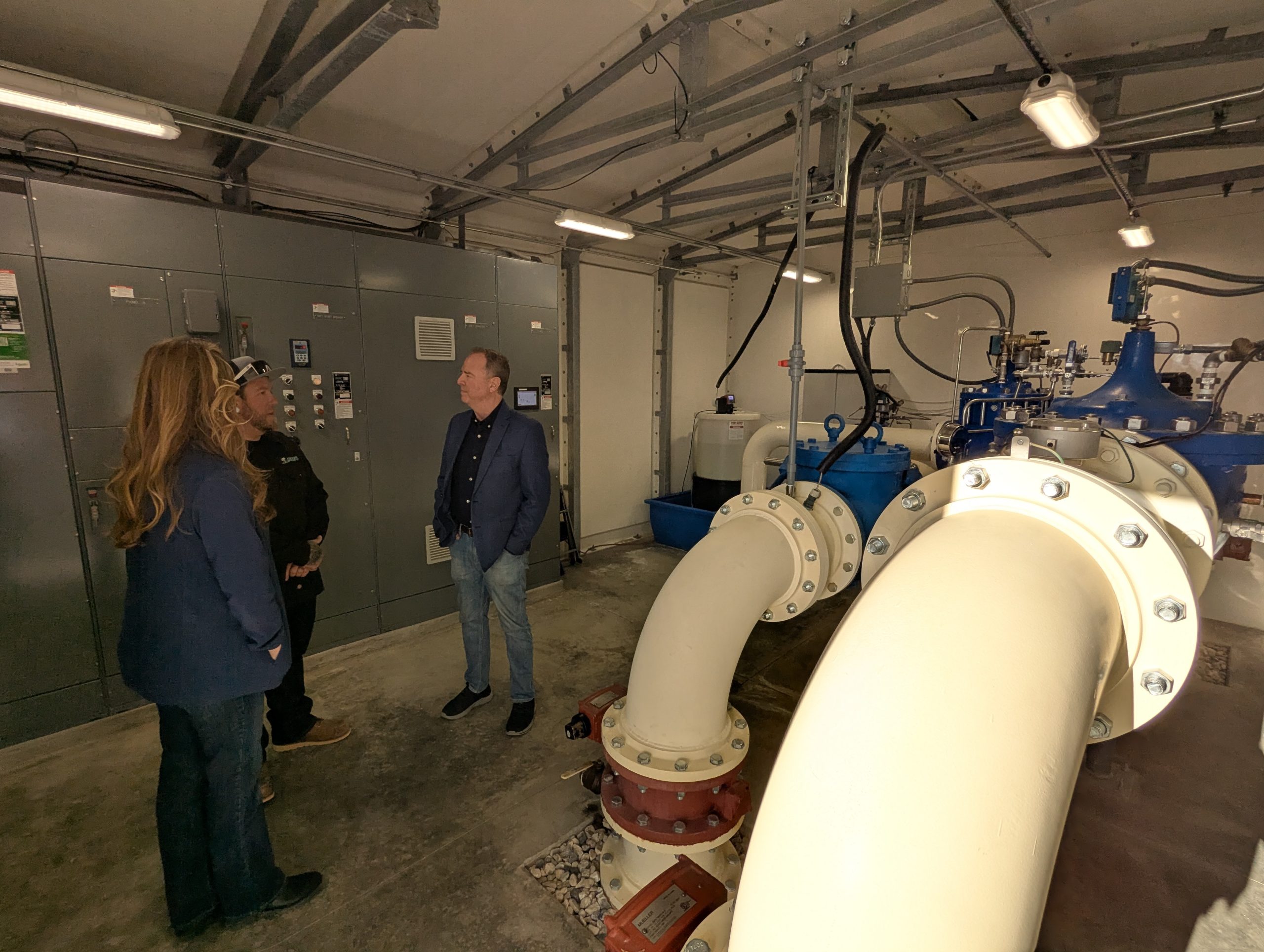
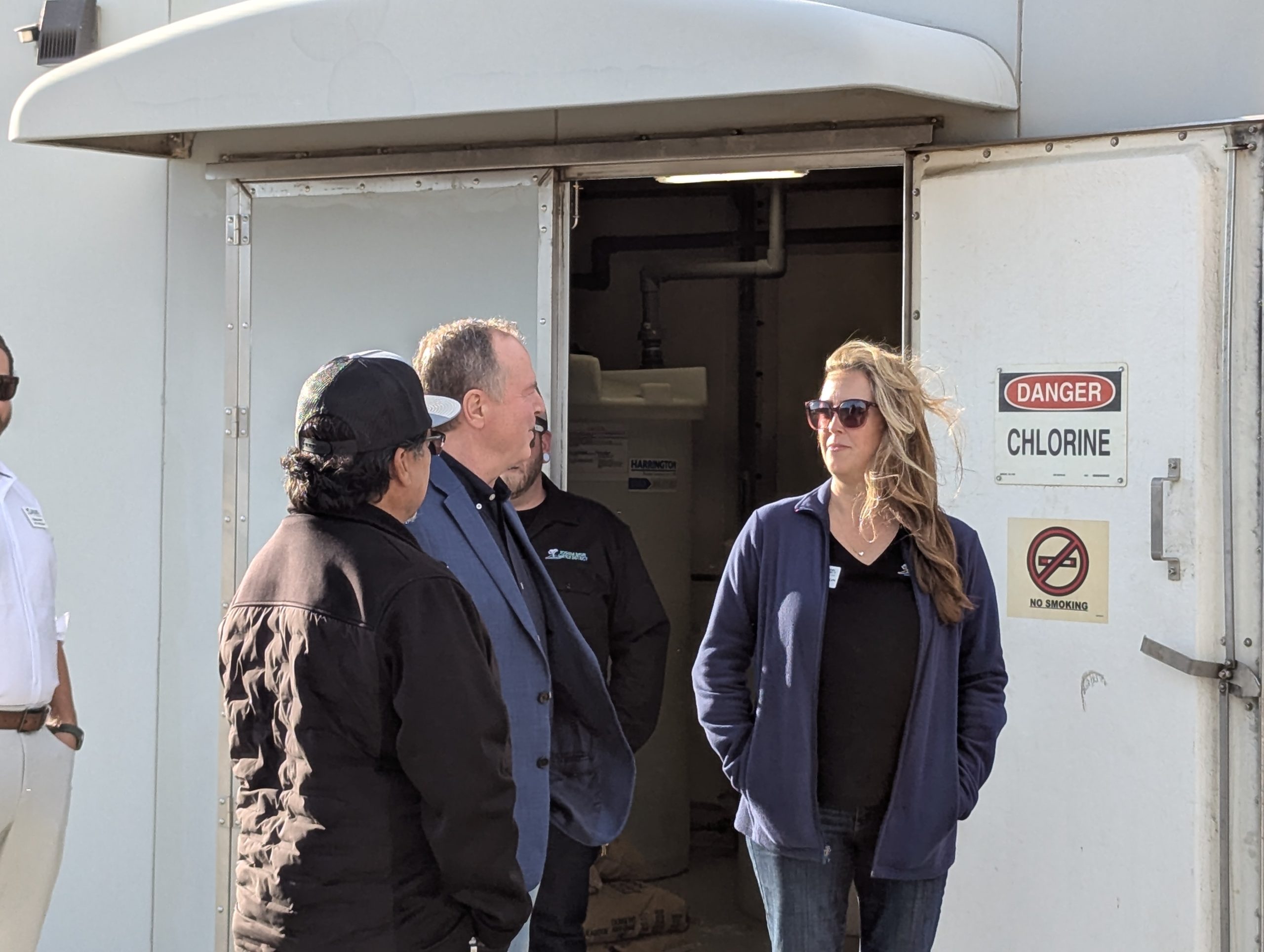
After Senator Schiff visited the JBWD offices, he joined the group for a tour of one of the district’s wells located right off Twentynine Palms Highway. Johnson says that the short visit was an important one for the water district.
“We’re a very popular community… everybody knows Joshua Tree but we’re still small. To come out here of all the places you can visit in California and take the time to visit us and understand our problem was severely appreciated. We were really happy and it makes us know that we’re not going unheard. The efforts that we’ve taken so far by hiring lobbyists and by helping hire municipal advisors for us to get through all this work, it’s not going unnoticed.”

Joshua Basin Water District customers are already facing an increase in water rates over the next few years, and that’s not including the total cost of chromium-6 removal or a possible sewer system that is being “explored” by San Bernardino County.
Senator Schiff says that federal help may be coming:
“What I’m able to do individually — and Senators have some ability to direct money to important projects like this — is very small compared to the need. We really need programs like the Water Infrastructure Innovation Act (WIFIA) that funds grants for water systems.
“We’ve got state revolving funds that also provide support for local efforts to clean water. All of those things need to be adequately resourced, because we can’t, I think, rely on people in small communities or even some large communities to do it on their own.
“But particularly small communities that have a lot of aging infrastructure… it just isn’t feasible. It’s not economical. The costs would be prohibitive. So I think clean water is a right, and we need to make sure that everybody has that right.”