Recap: The first meeting of the Yucca Valley Animal Shelter Committee

Editor’s Note: This is a longer version of the radio story we ran on the Yucca Valley Animal Shelter Committee. Because the meeting doesn’t have a publicly available video or audio version, we hope this longer version provides more information on what happened at the Town’s first workshop focused on their Animal Shelter.
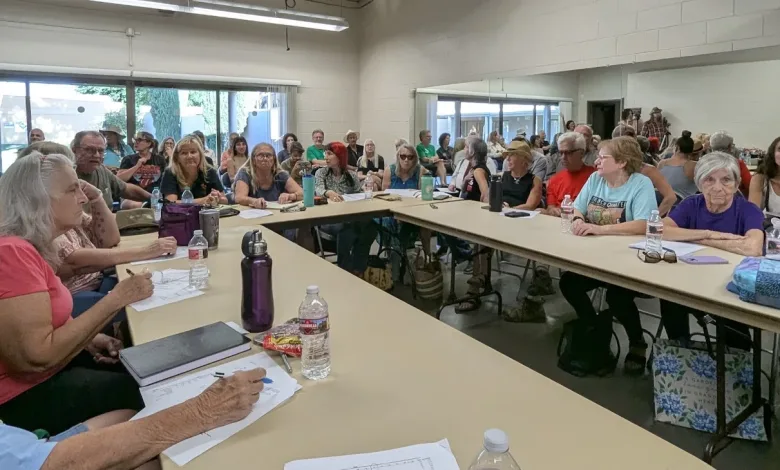
The first meeting of the Yucca Valley Animal Shelter Committee took place this past Thursday, August 21st. This was the first workshop style meeting for the separate standing committee that was born out of months of discourse at town council meetings regarding the shelter and more specifically former shelter animal care and control manager Doug Smith.
Attending from the Yucca Valley Town Government was Councilmember Jim Schooler and Mayor Jeff Drozd, along with Town Manager Curtis Yakimow and Deputy Town Manager Shane Stueckle.
There were at least 60 people in the Cholla room at the beginning of the meeting, though more trickled in after the 4.30 start time. Council Member Jim Schooler began with a Pledge of Allegiance and then some background on the meeting.
This is a good time to talk about the audio…
The room at the Yucca Valley Community Center was packed, but it didn’t have a PA system. It was also the start of a heat wave and a couple reliable but noisy box fans were running in the background. I wasn’t prepared with the right microphone, but we cleaned up the audio the best we could. We’ll come more prepared next time. On to the meeting…
Introduction and Housekeeping
Here’s Council Member Jim Schooler:
“We want to have these meetings track the progress. The (Town) Council put together 32 action items, action steps that can take place over time. Some are already well underway and some are yet to be addressed until we get staffed up.”
Town Manager Curtis Yakimow then moved ahead with the agenda, which had some housekeeping items on it. First up: who’s going to chair the committee? Council Member Jim Schooler said he would do it, as Mayor Jeff Drozd said he had too much on his plate.
Mayor Drozd then spoke up about how the Brown Act applies to the meeting:
“Everything that we talk about here, well this is public, but I can talk to Jim about something and he can talk to me, but we can’t talk to any other council members. That’s a Brown Act thing. I can’t go to Council Member Dennison and say this is my opinion about something and so it’s between me and Jim, that’s it. So I just want to make that very clear.”

The meeting time was moved forward to 5:30 p.m. after most agreed it would help attendance. The official name keeps it simple, landing on “Yucca Valley Animal Shelter Committee” and the frequency of the workshops was ultimately decided to be monthly.
This is one of the first points in the workshop where the back-and-forth discussion format showed the difference between this and a Town Council meeting, where comments are limited to three-minutes and Council Members don’t have the freedom to converse during public comments.
Jim Schooler: “If that’s inconvenient for everybody here, he would refer a little bit later. Any objection to doing that? Anybody have a problem with that? What would be better? 5:30?
“Okay, we’re going to give everybody an opportunity. So 5:30 on Thursdays would be okay with us.”
The next item on the agenda was affirming the very workshop format that allowed the previous discussion to take place. (It was a resounding yes.)
Deputy Town Manager Shane Stueckle then introduced some of the staff from the animal shelter who were in attendance. Nathan and Ryan are Animal Control Officers and Shelter Specialists and they’ve both been with the Yucca Valley Animal Shelter for a year and a half. Amanda is also in Animal Control and has been with the shelter for about three months.
Social Outreach and Shelter Stats
Stueckle then handed the presentation over to Brooke Dudra who’s been taking care of the majority of the social media campaigns and advertising outreach for the shelter, a job she volunteered to do outside her regular position as an administrative assistant for the public works and engineering department.
You’ve probably seen the campaign she’s worked on. The town is advertising the adoption events on Z107.7’s website as well as in the Hi-Desert Star which is also running a pet of the week in their print edition.
You may have also seen the ads if you’re on Instagram or Facebook. The campaigns are catchy and the images are cute and eye-catching. She’s also facilitated getting pictures of all the adoptable animals onto the town’s website.
Shane Stueckle then shared some statistics on the shelter, many of which received applause. Such as the adoption rate increasing to just over 34%, almost double that of 2024’s rate of 18%.
Here again is Shane:
Shane Stueckle: “Our euthanasia rate was a deplorable 54% for calendar year 2024. Our euthanasia rate for the first seven months of this year is at 23.19%.
He says the shelter is also at 65% for cat adoptions and the cat euthanasia rate is at 25%, down from last year which was in the 60 percentile. Brooke also spoke about the town’s spay and neuter events and she says they hope to get the second event scheduled in September as Animal Action League was closed for the month of August.
Shane Stueckle says that the operational review of the shelter presented a budget that would support quarterly spay and neuter events but whether that budget policy is approved is up to the Town Council. Someone in the audience asked if the animal shelter asks any sort of questions when owners turn in animals to the shelter. Ryan responded directly.
Ryan (Animal Control): “So typically we have a contract that’s an owner relinquishment contract that they fill out. It goes over the date that they have to basically if they change their mind and they want the animal back and then after that we put the animal up for adoption. It has things on it like ‘reason for relinquishment’ and oftentimes we’ll give them another sheet of paper that has questions about the animal’s personality like is it good with children, is it good with cats, things like that.”
Stueckle added that the shelter does offer food to owners who are giving up their pet for financial reasons and they want to implement some sort of ongoing communication with folks struggling to keep their pets to try and prevent another animal at the crowded shelter. He went on to say that the shelter currently has 59 runs with two or even sometimes three dogs in each run.
Stueckle: “Our shelter is pretty full. When we start and what the capacity we’ve been running out for the last couple months probably averaging around 105 to 110 we’re pretty full.”

In response to Mayor Drozd asking about outreach efforts to other rescues, Stueckle said that the amount of time and effort put into the outreach only added three or four rescue groups. He says with shelters across Southern California just as overburdened as Yucca Valley, getting new rescue groups on board hasn’t been an easy thing to do.
Co-president of the Joshua Tree No-Kill Shelter Board Glenn Harris then said that their shelter has been working with the town and the Yucca Valley shelter staff in the last few weeks and he wanted to acknowledge that the staff has been “awesome.” Chair Jim Schooler then thanked Harris for the tour he took of the recently expanded no-kill shelter.
Operational Review
With that it was on to the operational review. Town Manager Curtis Yakimow began by saying that the transition in leadership at the shelter – the retirement of former shelter manager Doug Smith – slowed down their ability to move on some of the action items faster. He says the immediate goal is to establish an interim leadership structure at the shelter for about three to six months so they can act on recommendations from the Town Council as part of that operational review.
They also need to review the animal care and control manager job description to “make sure that it’s consistent in title and duties with what we want to see moving forward.”
Yakimow said that after the interim leadership is established they expect to have completed the recruitment process with the hopes of having someone in the leadership role in four to five months. In many of the Town Council meetings leading up to this residents have frequently requested a volunteer program for the shelter especially when the public comment periods were filled with people telling stories of being turned away simply because there wasn’t any infrastructure. Before getting into the town’s update on the volunteer program, Shane Stueckle stressed the small size of the shelter staff.
Stueckle: “It can be difficult if we have someone calling in sick on the same day that someone’s got a vacation day. There’s some days we don’t have the dog runs clean until 2:30 in the afternoon. We open to the public at noon. We’re a small staff.
“I just want to communicate that we don’t we don’t have a big list of employees that can backfill.”

Stueckle says he hopes that the part-time employees currently helping out at the shelter will be able to stay on at least through December and that the shelter is still in the process of sharing what resources are necessary moving forward.
Volunteer Program
As for that volunteer program, there was a stack of applications at the meeting that day which folks could fill out and apply but that doesn’t mean they should expect to be out walking dogs in the next few weeks or even months according to Curtis Yakimow. He says that’s due to the transition in leadership and the search for former Manager Doug Smith’s replacement.
Yakimow also confirmed that the volunteer program will be open to ages 16 and up.
At this point in the meeting this is where the workshop format was really put to the test so to speak. Those earlier frustrations that were expressed about the slow rollout of any sort of volunteer program were brought back up here with one commenter characterizing watching the forward was like “looking at a snail walking backwards,” calling it “slow and painful.”
Similar audience feedback was audibly offered when Stueckle addressed the question about when a supervising veterinarian would start at the shelter.
Stueckle: So we’re in the process of changing that right now… changing the supervising veterinarian and starting on Monday Dr. Tillerman is going to be assisting us with walkthroughs.
The group loudly gasped, with some audience members shouting “WHO?” and “just check her Facebook page.”
Other questions were asked by the audience like “who’s running the day-to-day operations?” That’s Deputy Town Manager Shane Stueckle who says he works together with the animal shelter staff to make determinations on which pets are adoptable versus non-adoptable and other judgment calls.
Concerns about conditions continue
Allie Irwin is part of a vocal group of residents who demanded answers for a dog named “Howdy.”
Here she was talking about “Lady,” a recently adopted dog that Allie said was malnourished.
Ryan from the Yucca Valley Animal Shelter addressed Lady’s feeding schedule: “We did feed Lady every single day, every single animal gets fed everyday.”
Stueckle: “She was actually on a double-feed cycle.”
Ryan went on to say that “Lady” had been at the shelter for a long time which can add stress to an animal, not allowing them to keep food down and put weight on. Irwin pressed for an investigation into what went wrong in previous cases and complaints against the shelter like the previously mentioned Howdy.
Curtis Yakimow responded:
“Oh yes, specific to the animal (Howdy). We’ve identified a couple of different things that should have not occurred, some that should have occurred and we have committed to ensure that any animal that is coming out to a rescue group or as an adoptable animal meets our basic standards. Howdy did not and I was clear we made that clear to the public.
“We’re committed to ensuring that that doesn’t happen again and we feel that our process now with staff and leadership even in our interim capacity will ensure that animals that are coming back whether it’s rescue adoptable or otherwise meets those basic standards.”
Allie said in the case of “Lady” it seemed like those basic standards were still not being met.
More residents stood up and urged the town to speed up the volunteer program rollout repeating that community members are ready to help. A comment from a resident familiar with volunteer programs at shelters suggested having the program coordinated by a volunteer, which she said could help alleviate some overhead time and money-wise.
Some seeking investigation, including from law enforcement
A little over an hour after the start of the meeting, Chair Jim Schooler began to wrap things up when he was interrupted by resident James Porter.
James Porter: “I’m sorry, is this a Brown Act meeting? Is this meeting subject to the Brown Act? Because I believe every community member has a right to speak. I don’t think you should cut us off.”
Jim Schooler: “Okay I just trying to be respectful of time.”
James Porter: “No. I think there are other community members who would like to speak and not be cut off. I would like to be one. Yeah I’m going to follow up on Allie’s question about the investigation.
“The exit of Doug Smith does not absolve the town of responsibility to investigate the oversight failures that happened at the shelter and I think that’s what that’s what I’m feeling is the answer we’re getting is… ‘hey Doug’s gone.’ I know it’s not said out loud and regardless of whether he left by retirement or by forced retirement for whatever reason we will never know. However, he’s gone. That’s a great step but it doesn’t mean the failures of the council and the city management to make sure that the shelter ran correctly for the last few years is gone.
“We expect that that investigation will continue and that there will be accountability at the levels that there needs to be. We’re not going to let that go and we’ll be at every Town Council meeting to remind everybody of that moving forward”
Porter then offered a criticism of the town’s proposed plan for the volunteer program which wouldn’t begin with volunteers directly working with the animals.
James Porter: “My concern coming from a long time in a job in government is if you start your volunteers as a greeter or an office person you’re going to get less response because these people here – at least in my impression of talking with them – is we want to work with the animals, right?
“I don’t want to come and wash dishes. I’m not going to do that. I am not going to volunteer to answer your phone. I’m not going to do that. I’ll come clean your kennels if that’s what you need and I’ll work with your dogs but if you set a volunteer program up for failure it’s going to fail.”
Many in the audience said that they would wash dishes or answer phones, citing the fact that any volunteer position will help alleviate tasks that the small shelter staff can get overwhelmed with day-to-day.
Porter pressed on about an independent investigation into the shelter. Yakimow sought clarification from Porter saying that in the case of “Howdy,” the case had already been reviewed and he wasn’t sure if he was requesting something beyond the operational review.
Porter pushed for a law enforcement investigation:
“We’re going to say that if Doug Smith or a random unnamed person has committed neglect or has failed to provide basic services for animals, the fact that that individual is gone does not resolve the criminal behavior. Somebody has to look at that. I mean it can’t be Jeff Drozd. That has to be law enforcement who looks at that.”
At this point conversations between residents and the committee continued but started to splinter off as folks got up after the over hour-long meeting.
The September meeting of the Yucca Valley Animal Shelter is scheduled for Thursday, September 18th at 5:30 p.m.
