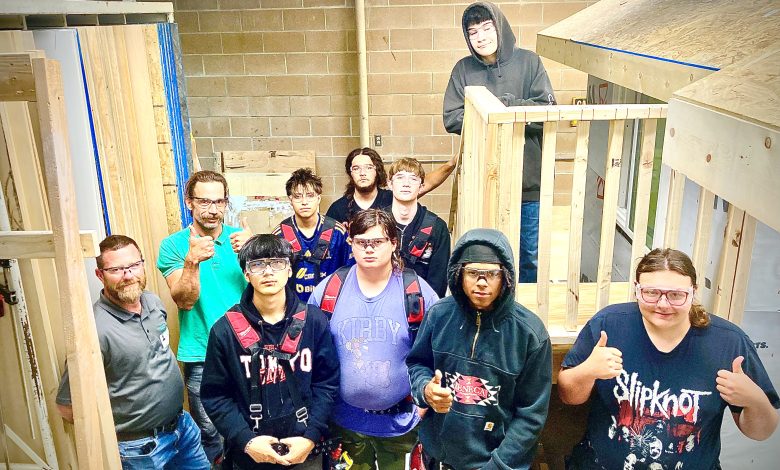
Mr. Little’s Construction 1 class teaches Twentynine Palms High School students proper technique and mindfulness in a growing trade

Secondary Building and Construction teacher Neil Little is in his third year guiding Twentynine Palms High School students through the intense but gratifying world of building from scratch. Beyond the importance of proper technique, Mr. Little teaches them focus, safety, communication, and mindfulness. Reporter Gabriel Hart met with Mr. Little during class, learning a thing or two about the value of hands-on trade in contrast to traditional academia.

Starting his construction career in Atlanta, GA in 1991, Neil Little began teaching at Twentynine Palms High School in 2022 for their Secondary Building and Construction. This class is an ROP, or Regional Occupational Program: a California state-funded technical educational program providing high school juniors, seniors, and 16+ sophomores with hands-on, career-focused training.
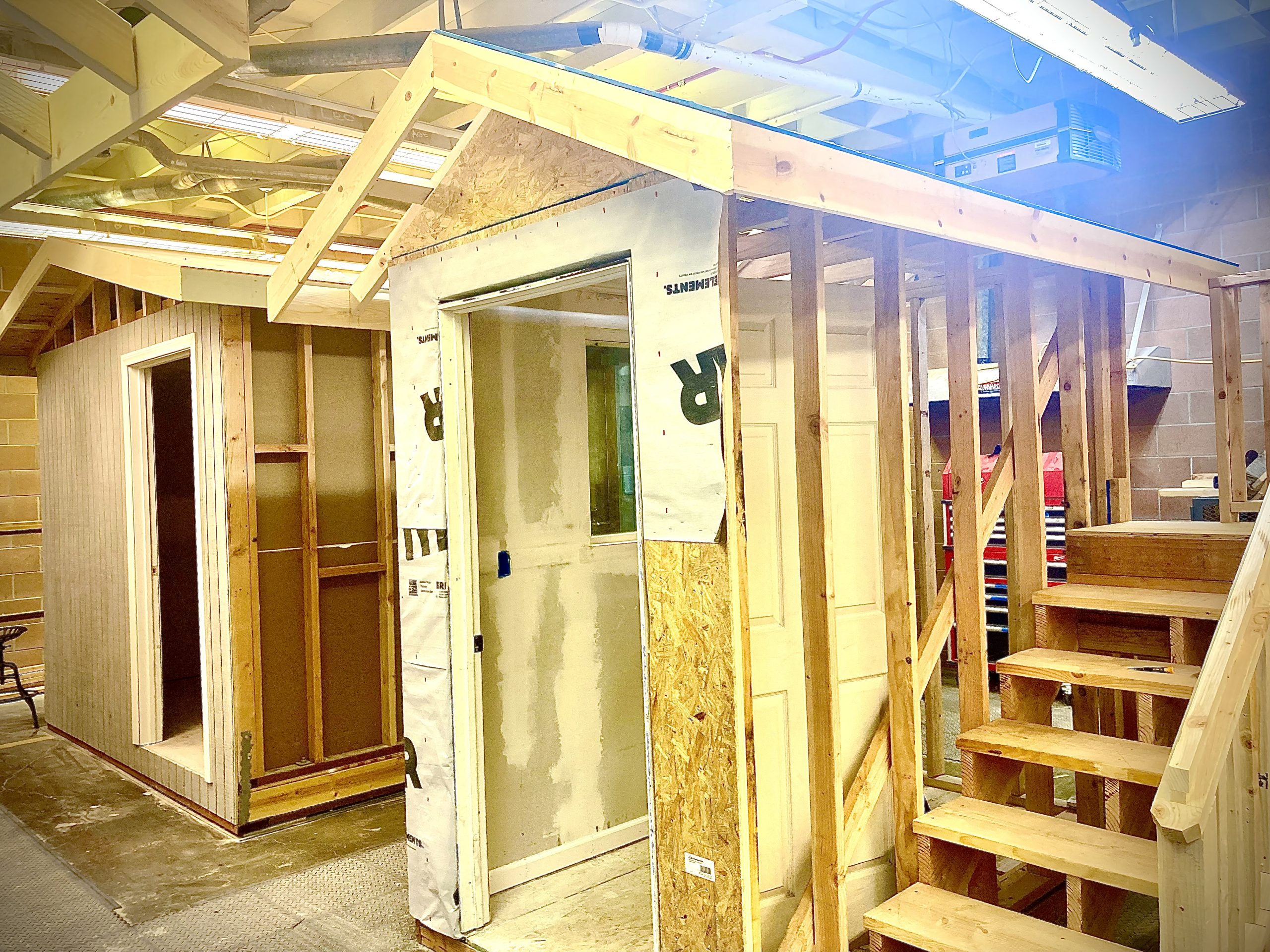
A visitor’s first steps into Mr. Little’s class will leave a substantial impression; the four tiny homes the class has built take up 3/4 of the room. “These buildings should go to the community, but we’ll have to just throw them away,” said Little, referring to a years-old request for an overhead door and outdoor covered workspace, two essential components that leave them behind standards met by other districts.
The bummer stopped there, however, as Mr. Little relayed the organizations behind the ambitious program, the rundown of the construction course, and his unique approach of mindfulness in a job where safety and attention is paramount.
In partnership with the Southwest Carpenters Union and their international training fund, Little says it is set up to train the next generation of carpenters, starting with the OSHA 10 in Construction Safety Authorization through Career Safe, then moving into the Carpenters Union curriculum which includes safety, hand tools, power tools, measuring devices and techniques, and basic layouts. Little says in the first year they start with smaller hand projects in the first semester: stools, birdhouses, and his own design: a mindfulness seat, an ergonomic kneeling stool that he and his students begin each class with.
“I need this to sit for more than ten minutes. But we do four minutes of mindfulness on this before we go to work, with mindful breathing.” Little says the mindfulness approach is becoming more common in this kind of environment, to “get centered and function at a higher level… a chance to reset before engaging in adult stuff where you need to be accountable for materials, methods, your fingers, and your coworkers.”


Mr. Little introduced me to Anthony, an exceptional second-year student and the class’s “champion nail driver.” “Anthony never played sports, doesn’t even know if he can play sports, but he drives a nail in two licks,” said Little, before instructing Anthony to set up a nail driving race with another student to show us the importance of speed and accuracy in construction where time is money.
He explained the program’s second year students and their leadership roles. “After OSHA and the little projects like the stools and such, they start moving into more group projects like these small buildings here. They started these around Thanksgiving last year… But for the second-year students, the idea is that they kinda run the shop in the second hour. The new kids are learning the new material the first hour, the second hour they’re implementing it all with the second-year students.”
With a nationwide shortage of construction workers, Little feels it especially on a local level. “In the Morongo Basin the shortage is massive, especially in highly skilled workers. I talk to people all the time who are looking for highly skilled people. I am preparing the kids for that, but my ultimate goal is to get them into more of an organized, structured system like the (Carpenters) Union, where they’ll gonna have stepped raises at a certain level and year, they’ll have retirement, full benefits, and be able to support their family.”
Little points to one student, Nathon Stapleton. Like a lot of kids raised through the pandemic in their formative years of isolation and screen time, Nathon was barely able to speak when he first entered Mr. Little’s construction class; “For example, for that kid, this class was a total game changer…” Now, Nathon is excelling, teaching other students and brave enough to speak to me after prompting from Little: “Nathon, tell him about yourself, don’t be shy!”

“Honestly, growing up, everyone I knew was somewhat in the construction trades, but I never picked up on it,” said Nathon. “The reason I chose this class is because in my other classes I didn’t really have a passion for them. Like I was in Dental Assisting, but I just couldn’t pay attention. And then this class, I thought would just be fun, but now I’m pretty good at it.”
Mr. Little testified to the class’s popularity as an alternative to traditional academia. “I have a lot of students who say this is the best class they’ve ever taken, or even the only class they’ve ever liked. I’ll hear from them years later saying they didn’t think they were gonna ever use this stuff but then it turns out to be the most useful thing for them: flipping houses, fixing their own, etc. Or kids that were not good traditional students who are now hugely successful making six figures a year.”
Copper Mountain College Construction Trades Instructor Brian Benton says both he and Mr. Little’s programs are collaborative, assuring high school students can transfer into CMC’s advanced study with the growing popularity of trade tech.
“This program is part of a resurgence across the country of vocational training, careers in technical education. And I have to give MUSD credit: they have their finger on the pulse of the community, because this is one of the critical programs. It serves employers and fills employment gaps in the community. But the funding sources for these programs aren’t available if we can’t prove these students can take these skills into the workforce and actually get a job that pays a living wage.”
While no females were seen in Mr. Little’s class, both he and Mr. Benton assure that female interest in construction trade is growing across the country, but not enough in the Morongo Basin. Little says he just has two females in his morning class out of his forty-six students but in the past, his female students showed leadership skills out of the gates.
“Typically, in the past, especially in this age range, the girls would be leading the shop. They’ve had a higher attention to detail, especially with the finish work,” said Little.
Benton added, “Females are a recognized underrepresented group in the construction industry. And this goes back to the funding sources: they encourage us to target groups who aren’t traditional construction workers. I probably have 10% females in my class, and they learn differently, with character traits you don’t normally see. They’re super detail oriented and ask way more questions, at least 3-4 times more questions than the guys. They’ll often engage with me when the lab has finished. I just see more thought going on into the ‘why’ we do things.”

Eighteen-year-old Richard Brese, another one of Little’s star students, was eager to talk about why he loves the class. “In the start of my junior year I saw the construction class. I was like ‘I want to do a class that’s not academic you know? Honestly, I like the idea that if there’s anything wrong with my house, I could just do it. And it’s also a fall back, like let’s say college doesn’t work out, I have like the skills to be able to work in the trades. I feel like with academics, a lot of it is conceptual, but with this I think something out and then I do it. I like the applying.”
Students interested in taking Mr. Little’s two-hour construction class can pick up a course request sheet from the counselor’s office and write in “Construction 1” as their first choice.
