Joshua Tree’s groundwater holds some answers to septic-to-sewer questions; county says the rest need more study

If you have heard rumblings of a possible sewer system in Joshua Tree but you aren’t exactly sure what is going on with it, you are not alone. In December of last year, San Bernardino County set aside $6.3 million dollars to explore the feasibility of a sewer system in the unincorporated village, which would also presumably answer whether a sewer system was needed… or desired.
Currently all of Joshua Basin Water District’s customers are on a septic system, which relies on the natural process of letting wastewater slowly leech back into the ground. This process is slow and over time too many septic systems can result in water with rising nitrate levels, which can be harmful to children and pregnant women.
Increased nitrates can also be a sign that a water table’s delicate balance with septic treatment might be tipping toward a more industrial treatment solution such as a sewer system.
So does Joshua Tree’s water have a nitrate problem?
According to Data Analyst Brian Hammer of Hammer Analytics, the answer is no.
Hammer gave a presentation at Monday’s meeting on the nitrate levels in Joshua Basin’s wells. Hammer says that he began the presentation when he was an employee at the Mojave Water Agency (MWA), where he worked for 22 years. “There’s changes taking place at Mojave Water Agency,” Hammer cryptically said at the beginning of his presentation. “I thought it was prudent if I was to exit, which I did. It became clear that this presentation was not going to be presented, I had some issues with that.”
Hammer says he used publicly accessible data and expanded on the presentation on his own time. The Mojave Water Agency sent a letter to the JBWD Board of Directors on Monday morning advising the board that the presentation does not reflect the official opinion or position of the MWA.
Read: What does the Mojave Water Agency do for the Joshua Basin Water District? (jbwd.com)

The presentation went over a lot of science and historical data for the five wells in the Joshua Basin Water District, and other than one of the wells which has seen a slight increase in nitrates over time, Hammer says “I want to assure you the Joshua Basin Water District does not currently have a nitrate issue in its public supply wells. Everything is below the maximum contamination levels. It’s well below the maximum contamination levels.“

Hammer gushed about the quality of the water in the district, saying that the water purchased by the district to “recharge” the aquifer is continuing to keep nitrates levels manageable while adding back to the water table.
Director Tom Floen reminded the board and the public that the district also routinely releases a water quality report which is available online.
County and council members clash over first phase
So if nitrates aren’t currently a problem in Joshua Tree’s water, why is the County exploring the feasibility of a sewer system to the tune of $6.3 million dollars, and what information is the county expecting to discover in the study?
Third District Supervisor Dawn Rowe sent a letter to the Joshua Basin Water District in August requesting that the board adopt a formal resolution taking one of two positions: support or oppose phase 1 of the County planning and feasibility work for the Joshua Tree Septic-to-Sewer initiative.
In response, the Joshua Basin Water District sent a letter with 63 questions from President Doolittle regarding clarification from the County on the project. Supervisor Rowe responded with another letter which answered four of the questions, but for the others, she says those will be answered through the findings of the first phase in the Septic-to-Sewer planning efforts.
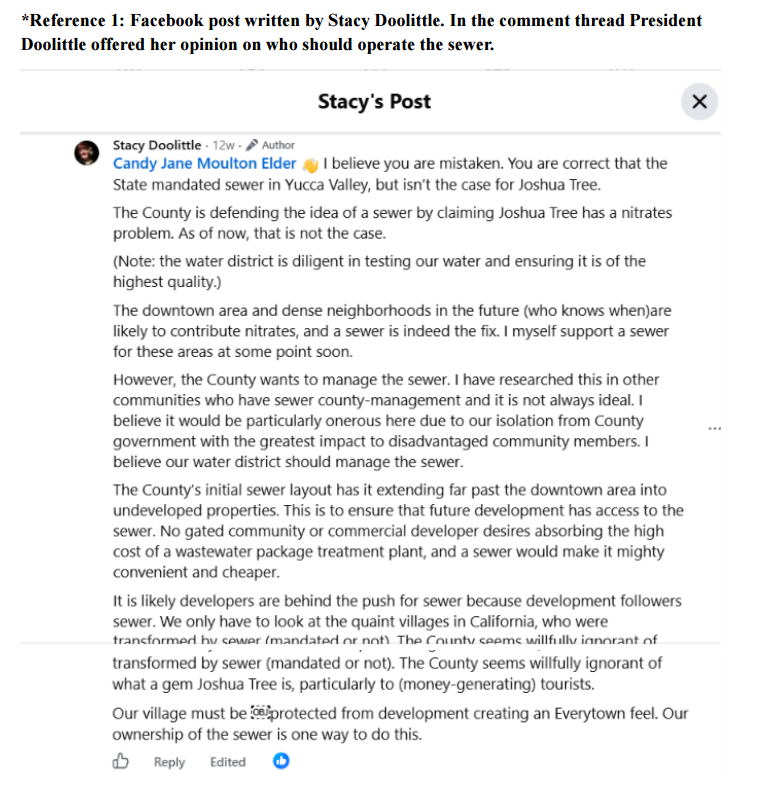

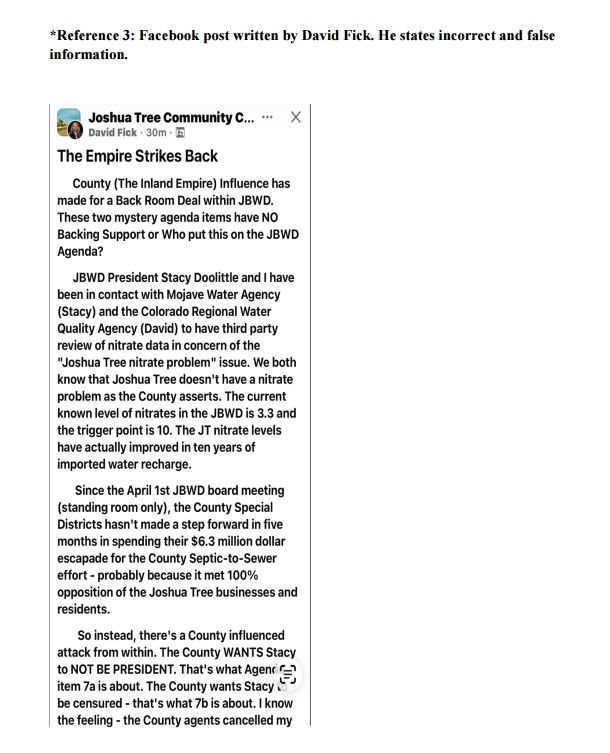
Rowe also states that those efforts are being undermined by personal statements by Board President Stacy Doolittle and Vice President David Fick. Doolittle and Fick also sit on the board of the Morongo Basin Conservation Association, and both have been outspoken in their skepticism of the county’s intentions regarding a sewer system.
The JBWD board adjourned after three hours into a closed-session.
JBWD General Manager Pro-Tem Anne Roman has put together a “Frequently Asked Questions” document which you can find below.
Previously reported: